How to Get Over Being Cheated On Without Turning Bitter
Infidelity wounds two things at once: your trust in her and your trust in your own judgement. You can rebuild both, and you don't have to become bitter to do it.

Video version: Getting over infidelity with your self-respect intact
Coming soon. Everything in the video is in the written guide below.
Finding out you were cheated on is a particular kind of pain. On top of losing the relationship, you're dealing with humiliation, a flood of questions, and a nagging voice asking how you didn't see it. Many men describe it as the floor dropping out: everything they thought they knew about the last months or years is suddenly up for review.
Two things get hurt at once. Your trust in her, and your trust in your own judgement. This guide helps you get through the first days, stop the replay, handle the anger safely and, eventually, rebuild both kinds of trust without hardening into someone you don't want to be.
In short
- In the first 72 hours, protect yourself: no big decisions, no confrontations after drinking, tell one person.
- You don't need every detail. Chasing them keeps the wound open.
- Anger is normal and useful in small doses. Give it safe outlets, not her inbox or social media.
- Her choice is about her choices. It is not a verdict on your worth.
- Bitterness feels protective but costs you the future. Aim for clear standards instead.
The first 72 hours
The first days after discovering infidelity are usually the most chaotic. Your body is in alarm mode: racing heart, no appetite, broken sleep. That's a normal stress response, and it's a bad state for making permanent decisions.
- Don't decide anything permanent for 72 hours unless your safety requires it. Big decisions can wait three days.
- Don't confront anyone after drinking, and don't confront the other man at all. It rarely helps and it can make things much worse.
- Don't post about it. Whatever you share publicly now, you'll still be living with in a year.
- Tell one trusted person what happened. Carrying it alone makes it heavier.
- Eat something, drink water and try to sleep, even if it's broken. Your body needs basic care right now.
If you share a home, you may need to arrange space quickly. Keep those conversations short and practical: who stays where, for how long, and what happens to bills and belongings this week. The emotional conversation can come later, if at all.
If you've had any thoughts of harming yourself or anyone else, please stop reading and reach out now: call or text 988 in the US (or Samaritans on 116 123 in the UK and Ireland), or your local crisis line or emergency services.
Stop chasing the details
After infidelity, many men want to know everything: when it started, how often, where, what was said. The questions feel urgent, as if knowing would make it hurt less.
Usually it does the opposite. Every detail becomes a new image your mind can replay at 2 a.m. Each answer raises three more questions. And the one question underneath all of them, "why wasn't I enough?", isn't one any detail can answer.
You're entitled to the facts that affect your decisions: whether it's ongoing, whether you need a health check, what it means for your living arrangements. Beyond that, ask yourself before each question: will knowing this help me decide anything, or will it just give me something new to replay?
When the replay starts anyway, treat it like any other urge. Name it ("this is the replay"), get up, move your body for ten minutes and change the room you're in. Our no-contact guide has a full 20-minute drill that works for replays as well as urges to text.
Anger: let it out, safely
Anger after being cheated on is normal. It's your mind recognising that something unfair happened. Swallowing it doesn't work; it comes out later as a short fuse with people who didn't do anything to you. But acting on it at her, at him or online almost always makes your situation worse and hands them the story.
Give anger a safe door instead:
- Physical: a hard training session, a heavy bag, a long fast run. Burn it off in your body, not your phone.
- On paper: write the angriest letter you can, every word, then destroy it. Never send it.
- Out loud, to the right person: a friend who can listen without fuelling it, or a counsellor.
- Time-boxed: give it a daily slot, ten or twenty minutes, then close the notebook and get on with your evening.
If the anger is spilling onto people who don't deserve it, our guide to anger after a breakup has a 90-second reset for the moment you feel it rising.
Aiden, 28, and the fourth message
Aiden found out about the affair through a friend. He spent a night writing furious messages, sent three, and was about to send a fourth to explain the first three. Instead he called his brother, did a hard workout, wrote the fourth message in a "Not sending" note and went to bed. The next morning he sent one short line saying he wouldn't be discussing it further, and blocked. He later said that night was the turning point, because it was the first time he'd chosen what he did instead of reacting.
It isn't a verdict on your worth
One of the most damaging thoughts after infidelity is: "If I'd been better, she wouldn't have done it." It's worth looking at that carefully.
Relationships can struggle for reasons on both sides, and it's healthy, later, to look honestly at your part in any distance or problems that built up. But cheating is a choice one person makes about how to handle those problems. There were other choices available: talking, counselling, ending things honestly. Her choice tells you about her choices. It isn't a measurement of your value.
Hold both truths at once: "I can learn from what went wrong between us" and "I didn't cause her to cheat". That's not denial. It's accuracy.
Bitterness: why it's tempting and what it costs
After betrayal, bitterness can feel like armour. "Never trust anyone again." "Women are all the same." Large parts of the internet will happily feed that story, because anger gets clicks.
The trouble is that bitterness doesn't protect you from the next bad partner; it just stops you seeing the good ones. It makes you suspicious of people who've done nothing wrong, keeps your ex at the centre of your thoughts and turns one person's choice into a rule about half the population. The cost is your future, not hers.
The better armour is clear standards: what you need in a relationship, what you won't accept and what early signs you'll now pay attention to. Standards protect you without closing you off.
Rebuild trust in your own judgement
The quieter wound is often self-trust: "How did I not see it?" Rebuilding it takes three steps.
- Look back honestly, once. Were there signs you explained away? Write them down without self-blame. Many people miss signs because they trust their partner, which is not a flaw.
- Turn them into green flags and red flags. What does honesty, consistency and openness look like in practice? Write five green flags you'll look for next time.
- Keep promises to yourself. Every small promise you keep, such as training three times a week, holding no-contact or going to bed on time, rebuilds the sense that your judgement is reliable.
When you're ready to trust again
There's no fixed date. A good sign is when you can think about her without your body reacting strongly, and when you want to date to choose someone rather than to prove something or stop feeling something. Until then, put your energy into your body, your friends and a goal that's yours. The guide to getting over a long-term relationship has a full 90-day structure.
This guide is educational, not therapy or legal advice. Infidelity can bring up intense feelings, and talking to a counsellor can help a great deal. If you feel hopeless or have any thoughts of harming yourself or someone else, call or text 988 in the US (or Samaritans on 116 123 in the UK and Ireland), or contact local emergency services immediately.
Start with the next seven days
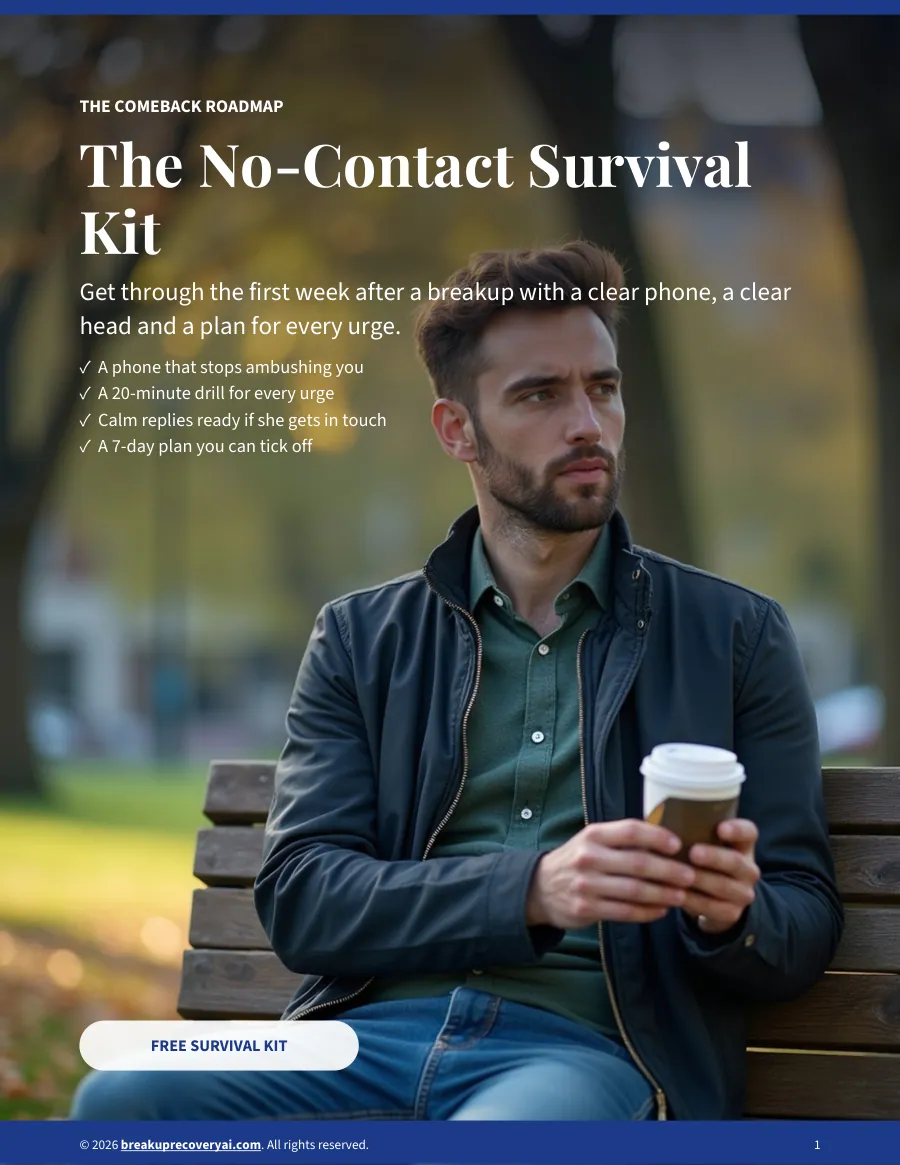
You don't have to sort out your whole future this week. Hold the line, protect your sleep and give the anger somewhere safe to go. The free Survival Kit below is built for exactly this stretch: a clean phone, a 20-minute drill, calm replies if she gets in touch, and a 7-day plan.
Step-by-step help for specific problems
Free survival kit
Get through the first week with a plan
In 30 minutes you finish with a phone that stops ambushing you, a 20-minute drill for every urge, calm replies ready if she gets in touch and a simple plan for your next seven days.