How to Do Handovers With Your Ex So the Kids Stop Feeling the Tension
Your children read the doorstep better than you think. A short, boring handover is one of the kindest things you can give them.
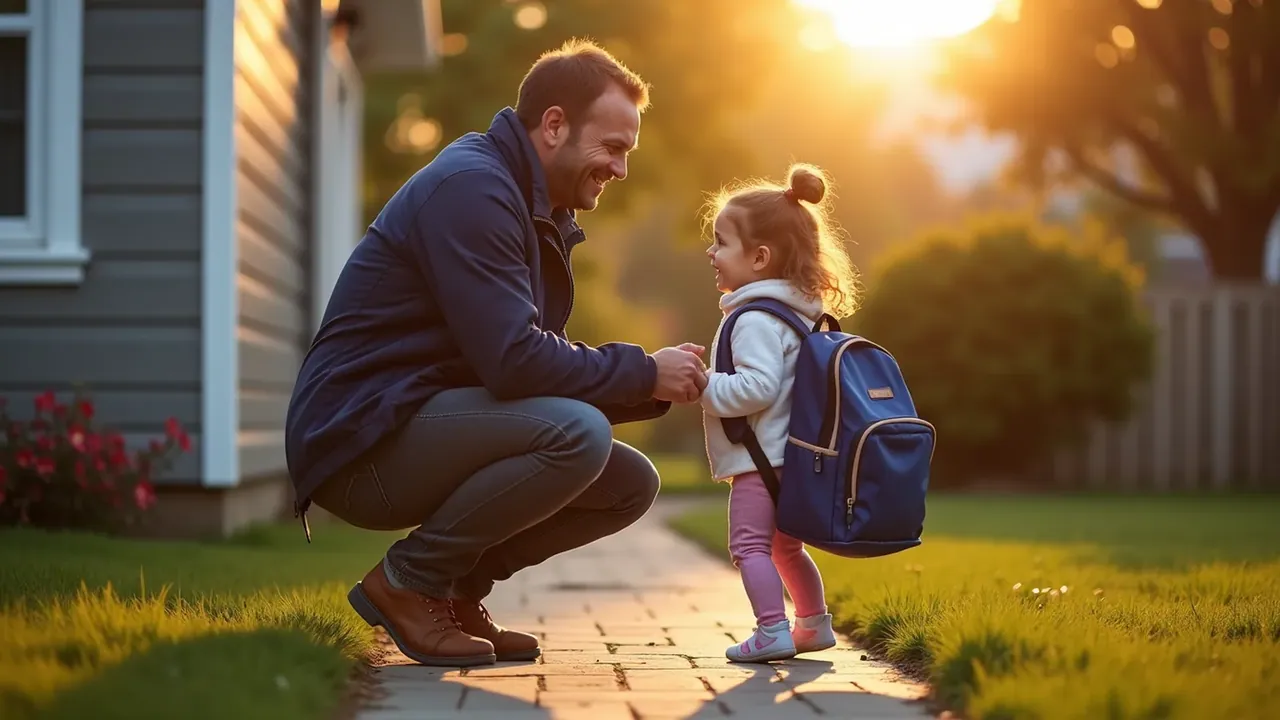
Video version: Two-minute handovers: a doorstep plan for dads
Coming soon. Everything in the video is in the written guide below.
If you're working out how to do handovers with your ex without the children feeling the strain, the short answer is: make them boring. Settle every practical detail in writing the night before, keep the doorstep to about two minutes, say one warm thing to the kids, and leave. Nothing on the step should need discussing.
"Handovers at the door are so tense the kids can feel it."
You know the moment: standing on her doorstep with the school bags, your jaw tight, and your daughter's eyes flicking between your face and her mum's.
Two-minute handovers with nothing to discuss and nothing for the children to pick up on. They walk out of one door and into your car without having to read the adults.
What your children notice at the door
Children are very good at reading the space between their parents. They notice the pause before you say hello, the way you look past her, the bag dropped a little too hard. They often can't name it, but they feel it.
Kids exchange anxiety is common. Many children get clingy, quiet or snappy around changeovers even when both homes are good. The switch itself is hard. When the adults are tense, it gets harder, because the child starts managing your feelings as well as their own.
None of this means you're doing it wrong. A tense handover is usually the only face-to-face contact two hurt people have all week. Of course it carries charge. The job is to take the charge out of the format, so it doesn't depend on how either of you is feeling that day.
The co-parenting boundaries guide covers the basics of calm handovers. Here's the detailed version, from the night before to the drive home.
How to do handovers with your ex in two minutes
- Send a short written message the night before with the time, place and any essential information.
- Pack and check the bags yourself an hour before, so nothing is forgotten and nothing needs a return trip.
- Take three slow breaths in the car before you get out, and decide on your one warm line to the kids.
- Greet her by name, hand over the bags, pass on nothing new, and turn your attention to the children.
- Say goodbye or hello to the kids with your full warmth, then leave within two minutes.
- Plan the first hour afterwards, whether it's the drive home with the kids or your own evening.
The night-before message
Most doorstep tension comes from unfinished business: a forgotten PE kit, a change in times, a question about the weekend. Put it all in one message the evening before. "Hi. I'll be there at 6 tomorrow. Sam's inhaler is in the front pocket; he had it at lunch. Football boots are in the blue bag. Thanks." Now there's nothing to say at the door.
The first hour after
The transition between homes doesn't end at the gate. If you're collecting, plan a gentle routine: a snack in the car, the same playlist, no questions about their mum's house. If you're dropping off, plan your own next hour before you arrive. A walk, the gym or a call to a friend beats driving home to a quiet flat and replaying her face.
A doorstep handover script
Keep the words almost the same every time. Predictability is calming for the kids and for you.
Arriving: "Hi, Claire. Here are the bags. All the details are in my message."
To the kids, dropping off: "Have a brilliant week. I'll call you on Wednesday at 7, like always."
To the kids, collecting: "Hey, you two. Pizza tonight, and you're picking the film."
If she raises something new: "Good point. Can you message me about it tonight? I'll reply tomorrow."
Leaving: "Thanks. Bye, see you Sunday."
That's the whole handover script. You don't need anything clever. You need something boring you can say even on a bad day.
Dev and the Sunday changeover
Dev, 41, did Sunday handovers at his ex's door, and his son Kai, 7, cried in the car almost every week. Dev started sending the night-before message at 8 p.m. every Saturday and using the same four lines at the door. He also brought a small bag of crisps and Kai's favourite song for the drive. After three weeks the handovers were under two minutes. Kai still went quiet in the car for ten minutes, but the crying stopped by week five.
Common mistakes at changeover
- Saving questions for the doorstep. It feels efficient but puts adult business in front of the kids. Fix: questions go in writing, always.
- Lingering to prove you're fine. Hanging around to look relaxed reads as tension. Fix: two minutes, then leave.
- Asking the kids about her house in the car. They feel like reporters. Fix: talk about what's next at your place.
- Arriving wound up. Rushing from work straight to the step means you arrive tight. Fix: park five minutes early and breathe. If you've been reaching for a drink to get through it, read drinking before seeing your ex.
- Using the handover to show displeasure. A cold look is a message the children read too. Fix: save the feelings for your notebook, a friend or a counsellor.
When doorstep handovers keep going wrong
Some handovers stay tense however well you prepare. That's not a reason to keep forcing them. A neutral handover location often fixes it in one step. School is usually the simplest: one parent drops off in the morning and the other collects at 3:15, so you never meet. A grandparent's house or the children's sports club can work at weekends.
If things are seriously hostile, or there are arguments in front of the children, talk to a family mediator about a written handover arrangement. Any question about custody terms or court orders is one for a family lawyer, not this article. If you ever feel unsafe, or worry about the children's safety, contact the police or emergency services. If there are threats, control or violence between you, mediation may not be safe or suitable; tell your lawyer, and in the US the National Domestic Violence Hotline (call 1-800-799-7233 or text START to 88788; in the UK, the National Domestic Abuse Helpline on 0808 2000 247 or the Men's Advice Line on 0808 801 0327) supports men too.
Tense handovers co-parenting advice often stops at "stay calm". Calm is easier when the message traffic is calm too, so it's worth pairing this with the two-reply rule in co-parenting with a difficult ex.
Looking after yourself after the door closes
Dropping your children off and driving away is one of the hardest small moments of separated fatherhood. Give it a ritual. Some dads go straight to the gym. Others sit in a café for twenty minutes with a book, or walk the same loop of the park every Sunday. The point is to have somewhere to put the feeling.
If the evenings after a drop-off are the hardest part, the free Survival Kit has a 20-minute drill for exactly that window.
- Handovers take two minutes or less most weeks.
- You arrive with nothing to discuss, because it was sorted in writing.
- The kids look at you, or at their bags, not back and forth between your faces.
- You have a plan for the hour after, and you use it.
- If a sign is missing after a month, try a neutral location such as school before anything else.
Key takeaways
- Make handovers boring: a message the night before, two minutes on the step, a warm goodbye.
- Use the same few lines every time; predictability calms everyone.
- New questions go in writing, never on the doorstep.
- School or another neutral place can remove the face-to-face moment altogether.
- Plan the hour after, so you're not alone with the replay.
Questions people ask
How long should a handover with your ex take?
Aim for about two minutes. That covers a greeting, the bags, one piece of essential information and a warm goodbye to the children. Anything longer usually means adult business is being discussed on the doorstep, which is exactly what children pick up on. Send the practical details in writing the night before so there is nothing left to talk about in person.
Why do kids act up after a handover?
Moving between two homes is a big transition, even when both homes are loving. Many children are tired, clingy, quiet or irritable for an hour or two after a changeover, especially if they sensed tension. It is usually about the switch, not about you. A predictable routine for the first hour at your place, such as a snack and some quiet time, often helps.
Where is the best place for a handover?
If doorstep handovers are tense, a neutral handover location removes the face-to-face moment altogether. School is often the easiest: one parent drops off in the morning, the other collects in the afternoon. A grandparent's house, a sports club or a quiet public place also work. Agree the place in writing and keep it consistent so the children know what to expect.
What if my ex wants to talk at the handover?
Keep it friendly and brief, then move the conversation elsewhere. A line such as 'Good point, can you message me about it tonight?' is polite and closes the topic without a scene. If she pushes, repeat it once, say goodbye to the children and leave. Discussing arrangements in front of the kids is the main thing that turns a handover tense.
Not therapy, and no promised results
BreakupRecovery is educational self-help, not therapy, counselling or medical care, and it does not promise any particular result or timeline. Recovery looks different for everyone. Examples are illustrative composites, not real clients. If you feel hopeless or have any thoughts of harming yourself, call or text 988 (the US Suicide and Crisis Lifeline); in the UK and Ireland, call Samaritans on 116 123, or contact your local crisis line or emergency services right away. Read the full disclaimer.

Free survival kit
Steady yourself before the next handover
In 30 minutes you finish with a phone that stops ambushing you, a 20-minute drill for every urge, calm replies ready if she gets in touch and a simple plan for your next seven days.