Can't Sleep From Divorce Stress? Park the 1 a.m. Maths Until Morning
The sums you do in the dark are never the right sums. Give them a time in daylight instead.
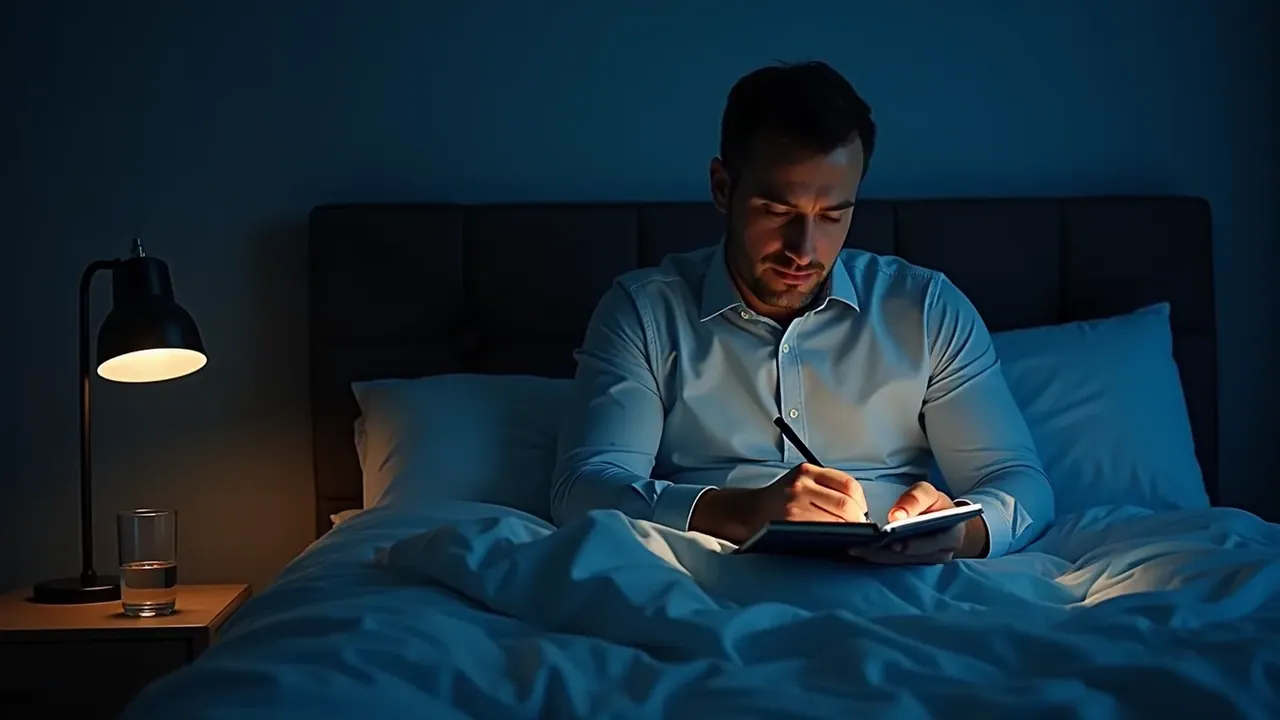
Video version: The 1 a.m. divorce maths, and how to park it
Coming soon. Everything in the video is in the written guide below.
If you can't sleep from divorce stress, the most useful change is to give your worries a different time. Write them down before bed in three columns, act, wait, or out of my hands, and book a 20-minute worry slot for the next afternoon. When you wake at 1 a.m., the job is not to solve anything. It's to note the worry and postpone it.
"I lie awake doing the maths on the house, the solicitor and the school holidays."
Lights off, around one in the morning, and your head starts running numbers: the mortgage, the legal fees, who has the kids in August.
Your worries are written down with a time to deal with them, so they stop running all night, and you wake up with a list instead of a headache.
Why the divorce maths comes out at night
In the day, your attention is full: work, kids, traffic, emails. At night those distractions go, and anything unfinished rises to the surface. Divorce gives you a lot of unfinished things.
Your brain is also worse at proportion when it's tired. The same question about the house that felt manageable at 3 p.m. feels like a disaster at 1 a.m. That's why divorce anxiety at night, with its racing thoughts at night after separation, often has a doom-laden quality that fades by breakfast.
And there's a trap. Lying awake trying to solve the problem feels responsible. It isn't. You can't phone a solicitor at 1 a.m., you can't check the figures properly, and you're making decisions with your worst thinking. The worry is real. The timing is wrong.
The pillar guide, how to sleep after a breakup, introduces the worry list. Here's a version built for the specific load of a divorce.
A worry plan for when you can't sleep from divorce stress
- Write every worry down an hour before bed, as quickly as you can, one per line.
- Sort each into three columns: things I can act on, things I'm waiting on, and things out of my hands.
- Give each "act" item one next step and a day, such as "Email solicitor re: house valuation, Tuesday".
- Book a 20-minute worry slot for tomorrow, at the same time each day, such as 5:30 p.m.
- Keep the notebook and a pen by the bed for anything that surfaces in the night.
- If you wake and your mind starts racing, write the worry down, add "slot", and go back to your breathing.
The three columns
Sorting is what takes the heat out. Looking at it on paper, many men find that most of the night's worries are in "waiting" or "out of my hands". The valuation hasn't come back. The court date isn't set. Her plans for August aren't decided. None of those can move tonight, and seeing that in writing makes it easier to let them sit.
The "act" column is usually shorter than it felt. Give each item one concrete next step, not the whole problem. "Sort out finances" is a weight. "Ask the bank for the mortgage statement on Monday" is a task.
The worry slot
A worry slot works because your brain learns that worries have a time. When one pops up during the day or at night, you tell it "5:30". At 5:30 you sit down for 20 minutes, go through the list and update it. Then you stop, even if it isn't finished.
When you wake at 1 a.m.
Have a short plan you can follow half-asleep, so you're not deciding anything in the dark.
1. Don't check the time or your phone.
2. Notebook: write the worry in five words, add "slot".
3. Breathe in for four, out for six, ten times.
4. Still racing after 20 minutes? Get up, dim light, paper book, back to bed when sleepy.
5. Remind yourself: "Nothing gets decided tonight. It's on the list."
Lee's notebook
Lee, 43, was waking at 1 or 2 most nights, running through the sale of the family house and his solicitor's last email. He started writing his list at 9:30 p.m. and found that of eleven worries, three were "act", five were "waiting" and three were "out of my hands". He set a 6 p.m. worry slot after work. In the first week he still woke four nights out of seven, but used the notebook and was back asleep in about half an hour. By week three he was waking twice a week, and he'd moved two "act" items to done.
Sleep mistakes during a divorce
- Reading legal emails in bed. It hands your brain new material just before sleep. Fix: no divorce admin after 8 p.m.
- Solving problems in the dark. Night-time decisions are rarely good ones. Fix: write it down, decide in the worry slot.
- Drinking to get to sleep. Alcohol can help you drop off but tends to break up the second half of the night. Fix: keep evenings mostly dry and see what happens to the 1 a.m. wake-ups.
- Scrolling when you wake. Bright screens and fresh content wake you up further. Fix: phone charges outside the bedroom.
- Catching up with long lie-ins. It shifts your body clock and makes the next night worse. Fix: get up at roughly the same time every day, even on weekends without the kids.
Sleep hygiene still matters
The worry plan works best on top of the basics of sleep hygiene: a regular wake time, daylight in the morning, movement during the day, caffeine before noon, a cool, dark bedroom and a wind-down that doesn't involve your phone. None of it is glamorous. All of it helps.
If the stress is affecting your day too, the fixed-slot idea also works at the office, which how to stay focused at work during divorce covers. The free Survival Kit has a full section on sleep, alcohol and the 3 a.m. mind.
Legal and money questions belong with your solicitor, a mediator or a financial adviser; this post is about getting them out of your night, not about answering them. If poor sleep has gone on for more than a few weeks, see your GP; insomnia is worth raising, and a doctor can look at what's behind it and talk you through the options. And if the nights bring thoughts of hopelessness or harming yourself, read feeling hopeless after divorce, and call or text 988 in the US (or Samaritans on 116 123 in the UK and Ireland) or your local crisis line straight away.
- You write your worry list most nights before bed.
- You have a daily worry slot, and you use it.
- When you wake, you reach for the notebook, not the phone.
- Most nights you're back asleep within half an hour.
- If you're still awake for hours most nights after three weeks, see your GP.
Key takeaways
- Night-time worry isn't problem-solving; it's the wrong time for real worries.
- Sort worries into act, waiting and out of my hands.
- Give each "act" item one small next step and a day.
- A daily 20-minute worry slot teaches your brain worries have a time.
- Persistent insomnia, or hopeless nights, are a reason to see a doctor.
Questions people ask
Why does divorce stress get worse at night?
During the day your attention is pulled by work, the children and other people. At night those distractions disappear, your body is tired and your brain's ability to put worries into proportion drops. Problems that felt manageable at 3 p.m. feel catastrophic at 1 a.m. It is a normal pattern, which is why worries are better handled at a planned time in daylight.
What is a worry slot?
A worry slot is a fixed 15 to 20 minutes each day, ideally in the late afternoon or early evening, when you deliberately go through your worries on paper. When a worry pops up at other times, you note it and postpone it to the slot. It teaches your brain that worries will be dealt with, so they have less need to demand attention at night.
Should I get up if I can't sleep because of stress?
If you have been awake for around twenty minutes and your mind is racing, getting up usually helps. Go to another dim room, write down what is on your mind, and do something calm such as reading a paper book until you feel sleepy. Avoid screens and bright lights. Lying in bed wrestling with thoughts tends to link the bed with being awake.
When should I see a doctor about not sleeping during divorce?
See your GP if poor sleep has lasted more than a few weeks, is affecting your work, your driving or your mood, or if you are relying on alcohol or over-the-counter pills to sleep. A doctor can check for other causes and suggest treatments, including talking therapies for insomnia. If you feel hopeless or have thoughts of harming yourself, seek help the same day.
Not therapy, and no promised results
BreakupRecovery is educational self-help, not therapy, counselling or medical care, and it does not promise any particular result or timeline. Recovery looks different for everyone. Examples are illustrative composites, not real clients. If you feel hopeless or have any thoughts of harming yourself, call or text 988 (the US Suicide and Crisis Lifeline); in the UK and Ireland, call Samaritans on 116 123, or contact your local crisis line or emergency services right away. Read the full disclaimer.

Free survival kit
Sleep better this week
In 30 minutes you finish with a phone that stops ambushing you, a 20-minute drill for every urge, calm replies ready if she gets in touch and a simple plan for your next seven days.