Feel Hopeless After Divorce? Signs It's More Than Sadness, and Who to Call
Some days are just heavy. Some days are a signal to reach out. Knowing the difference, and having the numbers ready, matters.

Video version: When it's more than sadness: getting help after divorce
Coming soon. Everything in the video is in the written guide below.
If you feel hopeless after divorce, the most important thing is to know when it's more than ordinary sadness, and who to contact. If you have thoughts of harming yourself, or feel you can't go on, call or text 988 in the US (or Samaritans on 116 123 in the UK and Ireland), or call your local crisis line or emergency services now. If hopelessness has lasted most days for two weeks, book your GP this week.
"Some days I feel completely hopeless about the future."
It tends to arrive in the quiet after the kids leave, or after an email from the solicitor that seems to undo months of work.
You know the signs that it's more than ordinary sadness, and exactly who to contact, today if needed, with the numbers already in your phone.
If you're in crisis right now: in the US, call or text 988 (Suicide and Crisis Lifeline); in the UK and Ireland, call Samaritans on 116 123. Anywhere else, call your local emergency number or crisis line, or go to your nearest emergency department; findahelpline.com lists free crisis lines by country. You don't need to read the rest of this first.
Ordinary grief versus something more
Divorce is a major loss. You lose a partner, a household, daily time with your children and the future you'd planned. Grief after that can be intense, and it can include moments of feeling hopeless. That's human.
Ordinary grief usually comes in waves. You have hard hours or hard days, and also hours that feel okay: a laugh with the kids, a good training session, a decent night's sleep. Over weeks and months, the good stretches slowly get longer.
Something more serious tends to look different. The low mood is there most of the day, most days, and doesn't lift. Depressed after breakup men often describe it as a grey weight, or numbness, rather than sadness. It's not a weakness or a failure. It's a sign you need more support than you're getting, and that support works.
The pillar guide, feeling numb after a breakup, covers when it's more than sadness. This post puts the practical steps first.
Warning signs to take seriously
Only a doctor or qualified professional can assess what's going on. But these warning signs, lasting two weeks or more, mean it's time to get help:
- Low mood or hopelessness most of the day, most days
- Losing interest in things you used to enjoy, including time with the kids
- Big changes in sleep or appetite
- Exhaustion that rest doesn't fix
- Feeling worthless, or that your family would be better off without you
- Drinking more to get through the day or night
- Pulling away from friends and family
And these need help today, not next week: any thoughts of harming yourself or ending your life, making plans, or feeling you can't keep yourself safe.
What to do when you feel hopeless after divorce
- Save the crisis number in your phone now: 988 in the US, or your local crisis line.
- If you have any thoughts of harming yourself, call or text the crisis line or emergency services today.
- Book an appointment with your GP and tell them honestly how you've been feeling.
- Tell one person you trust how bad it really is, using plain words.
- Write a short safety plan and keep it where you'll see it on a bad night.
- Keep one small daily anchor: a walk, a meal, a shower, a call.
Telling your GP
Many men minimise it at the doctor's: "Just a bit stressed, really." Try to be plain instead. "Since my divorce I've felt hopeless most days for about a month. I'm not sleeping, and I've stopped enjoying anything." Your GP can talk through options, including talking therapies and other treatment, and can check for anything physical.
Telling one person
Pick someone who'll listen: a brother, an old friend, a parent. You don't need to explain everything. "I'm not doing well. I've been feeling pretty hopeless. I don't need you to fix it, I just needed someone to know."
Your safety plan
A safety plan is a short list you make on a calmer day, for the harder ones. Copy this into your phone and fill it in.
My warning signs: (for example, not sleeping, drinking alone, thinking the kids would be better off)
Things that help me a bit: (a walk, a shower, music, the dog)
People I can call: 1. ... 2. ... 3. ...
Professional help: my GP: ... | crisis line: 988 (US) or ...
Making things safer: (for example, no alcohol at home on bad weeks; anything I could hurt myself with put away or given to someone)
My reasons to keep going: (my kids' names, something I want to see or do)
Craig reaches out
Craig, 46, had been low since the house sale fell through. On a Sunday evening after dropping his kids off, he sat in the dark and thought, for the first time, that they'd be better off without him. It frightened him. He texted 988 and talked to a counsellor for twenty minutes. On Monday he booked his GP and told his brother. The GP referred him for talking therapy. He wrote a safety plan with his kids' names at the bottom. Three months later he still has bad days, but he hasn't had that thought again.
Mistakes men make with hopelessness
- Waiting for it to pass on its own. Sometimes it does; often it doesn't. Fix: two weeks of hopelessness is a reason to see a doctor.
- Telling everyone you're fine. Fix: tell one person the truth.
- Drinking to cope. Alcohol deepens low mood. Fix: keep alcohol out of the house on bad weeks.
- Thinking help is for weaker men. Asking for help is what strong fathers do for their children. Fix: book the appointment.
- Going it alone at night. Fix: crisis lines are open 24 hours; use them.
Small anchors while help kicks in
Treatment takes time to work, so keep a few small anchors: getting up at the same time, a short walk in daylight, one proper meal, one contact with another person each day. They won't fix everything, but they give the day a floor.
People help too. If you've let friendships slide, making friends after divorce as a man has a gentle weekly rhythm. If grief has been building because you've held it in for the kids, holding it together for the kids shows a safe way to let it out. Once you have professional support in place, the free Survival Kit offers gentle structure for the week; it's self-help, not a replacement for care.
This article is general information, not medical advice. A doctor or qualified therapist is the right person to assess and treat depression.
- The crisis number is saved in your phone.
- You've booked or seen your GP, if hopelessness has lasted two weeks or more.
- One person knows how you're really feeling.
- Your safety plan is written and easy to find.
- If you have thoughts of harming yourself at any point, you call the crisis line or emergency services that day.
Key takeaways
- Waves of grief are normal; hopelessness most days for two weeks is a reason to get help.
- Any thoughts of self-harm mean contacting a crisis line or emergency services today.
- Tell your GP plainly, and tell one trusted person.
- Write a safety plan on a calmer day, for the harder ones.
- Small daily anchors give the day a floor while treatment works.
Questions people ask
Is it normal to feel hopeless after divorce?
Moments of hopelessness are common after a divorce, especially after bad news, at handovers or on quiet evenings. If they come and go, and you still have days that feel okay, that is often part of grief. If hopelessness is present most of the day, most days, for two weeks or more, or you have thoughts of harming yourself, it is important to get help.
How do I know if I'm depressed after divorce?
Only a doctor or qualified professional can assess that, but warning signs include persistent low mood, losing interest in things you used to enjoy, changes in sleep or appetite, exhaustion, feeling worthless, trouble concentrating and pulling away from people, lasting two weeks or more. If several of these sound familiar, book an appointment with your GP and tell them honestly how you are feeling.
Who can I talk to if I feel hopeless after a breakup?
In the US you can call or text 988, the Suicide and Crisis Lifeline; in the UK and Ireland, call Samaritans on 116 123, at any time. Elsewhere, contact your local crisis line or emergency services. For ongoing support, your GP is a good first step, and a counsellor or therapist can help. Telling one trusted friend or family member how you really feel also makes a real difference.
What should I do if I'm having thoughts of suicide?
Please reach out now. Call or text 988 in the US (or Samaritans on 116 123 in the UK and Ireland), or call your local emergency number or crisis line, or go to the nearest emergency department. If you can, tell someone near you and stay with them. Remove or move away from anything you could use to hurt yourself. These feelings can be treated, and help is available right now.
Not therapy, and no promised results
BreakupRecovery is educational self-help, not therapy, counselling or medical care, and it does not promise any particular result or timeline. Recovery looks different for everyone. Examples are illustrative composites, not real clients. If you feel hopeless or have any thoughts of harming yourself, call or text 988 (the US Suicide and Crisis Lifeline); in the UK and Ireland, call Samaritans on 116 123, or contact your local crisis line or emergency services right away. Read the full disclaimer.
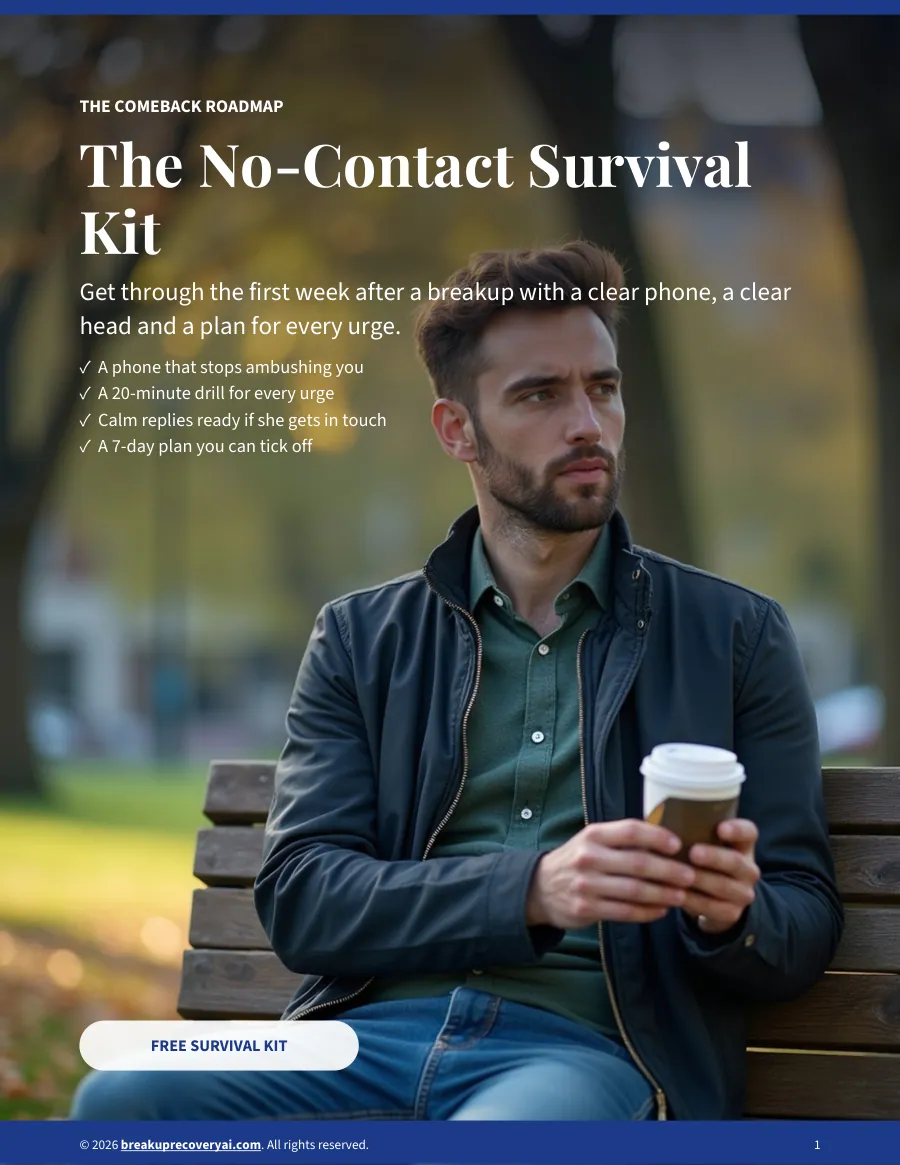
Free survival kit
Gentle structure for the days after you reach out
In 30 minutes you finish with a phone that stops ambushing you, a 20-minute drill for every urge, calm replies ready if she gets in touch and a simple plan for your next seven days.